St. Joseph’s Church(2009) - Moula-ali Parish
Patron
St. Joseph
Feast Day
1st May
Parish Celebration on
1st May
Pastoral Care
Archdiocesan Priest
Catholics
1100
Address
St. Joseph’s Church
Street No. 2, M.J. Colony Moula-ali, Hyderabad - 500 040, T.S.
Former Priests In-Charge / Parish Priests
Archdiocesan Priests: Fr. Yeruva Bala Showreddy (2009 - 2010), Fr. Thumma Solomon (2010 - 2012), Fr. Selvakumar Aloysius (2012 - 2018), Fr. Kommareddy Mareddy (2018 - 2023), Fr. Dodda Sunder (2023 - till date).
Brief History of Moula-Ali Parish
St. Joseph’s Church, Moula-Ali is a small but vast Parish in the Archdiocese of Hyderabad. Its Parishioners are spread out over an area that is almost 15 kms long (NFC Flyover-HB Colony- Moula-Ali-ECIL X Roads-Kushaiguda-Chakripuram X Roads- Nagaram-Rampally X Roads-Ahmedguda-Cheryal). For a further 10 kms on the Nagaram-Keesara stretch, except for one family in Keesara there is no other known Catholic family beyond Cheryal Village. The Parish is situated on the periphery of Ranga Reddy District with its north-eastern territory adjacent to Cheekatimamidi (Mandal), Nalgonda District which falls within the ecclesiastical limits of RCM Church, Bhuvanagiri (Bhongir) in the Diocese of Nalgonda.
Ecclesiastical units bordering the territorial boundaries of Moula- Ali Parish are: Arul Colony to the north-west; Balaji Nagar to the north; Bhuvanagiri (Nalgonda Diocese) to the north-east; Cherlapally to the east; Mallapur to the south-east; Shanthinagar to the south and Dayanandnagar to the west.
Moula-Ali obtained its name because of its famous Dargah. The history of the Dargah dates back to 1578 when an ill member of the Qutb Shahi court dreamt that Hazrat Ali, the son-in-law of the Prophet Mohammed, visited the hill. It is believed that the next day, not only was he cured, but Ali’s handprints were found there, and the Sultan immediately ordered a Dargah to be built over the prints and also a mosque. In 1935 the Department of Archaeology of the Nizam’s Dominion discovered a few iron- age burial sites near the hill. These excavations give credence to the belief that Moula-Ali had been inhabited since megalithic times. The Department of Atomic Energy (DAE) came into existence through a Presidential Order on 3rd August, 1954 and was placed under the direct charge of the Prime Minister of India. As the country gradually developed, DAE sought to set up two gigantic units, viz. ECIL & NFC. Open land beyond the Moula-Ali hill was found to be the ideal location. Moreover, located just 10 kms northeast of Secunderabad, Moula-ali seemed very attractive to the planners.
Electronics Corporation of India Limited (ECIL) was setup on 11th April, 1967 with a view to generate a strong indigenous capability in the field of professional grade electronics. The Nuclear Fuel Complex (NFC) was established in 1971 as a major industrial unit of Department of Atomic Energy. The complex is responsible for the supply of nuclear fuel bundles and reactor core components for all the nuclear power reactors operating in India. The above mentioned government institutions generated a lot of employment, both skilled and unskilled. Over the years many supporting small scale private manufacturing units proliferated in their vicinity. Thus the area developed rapidly with people moving in from all over India. In 1970 DAE Housing Colony was established comprising its own School, post office and community centre. Employees of ECIL, NFC and the various facilities of the Colony were allotted quarters in the Colony. St. Joseph’s Moula-Ali had its humble beginnings in “the Colony”, as it was then called. Catholics who secured residential quarters in “the Colony” sought a Church for their spiritual nourishment. The closest Church was Sacred Heart Church, South Lallaguda situated about 7 kms away. Public transport in those days was just one bus-service in the morning from Secunderabad Railway Station to ECIL and another in the evening. Hence, those patient enough to take the bus, found it easier to go to St. Mary’s Church, Secunderabad rather than Sacred Heart Church. Others just had to walk up to Sacred Heart Church, Lallaguda.
The Missionaries of St. Francis de Sales (MSFS) wanted to have some presence in Hyderabad, so the Provincial, Fr. Zacharias Munnakuzhumpil MSFS made a formal request in 1975 to Archbishop Samineni Arulappa for a Parish in the Archdiocese. Archbishop Arulappa readily agreed and bifurcated Sacred Heart Parish on 01st October, 1975 and entrusted the Catholics of Moula-Ali area to the pastoral care of MSFS Fathers. Fr. Philip Parackal MSFS was given charge of the new mission. His initial residence was at Trimulgherry, Mornington Road and within a month he moved to St. Anthony’s Church, Mettuguda. In January 1976 the land at Shanthinagar was purchased and on 11th February, Fr. Philip moved to the already existing house on the site at Shanthinagar. The construction of the Parish Church under the supervision of Fr. Mathew Thudian MSFS was taken up shortly. The Church was blessed on 24th January, 1978 by Archbishop Samineni Arulappa and was dedicated to St. Francis de Sales, the Patron of the MSFS Congregation.
Since Moula-Ali and the surrounding areas were now under the ecclesiastical jurisdiction of Shanthinagar Parish, some of the Catholics of “the Colony” (DAE Colony), particularly the office staff of DAE School and NFC employees, namely, Joseph J. Palakunnel, Thomas Kurian Placherial, Bartholomea Chowdary Mallavarapu and Simon Napolean approached the MSFS fathers (Missionaries of St Francis de Sales) for pastoral assistance. After Fr. Philip moved to Shanthinagar in 1976, he agreed to celebrate Sunday Masses in the Colony. He began by celebrating Sunday Masses in the homes of our Catholic people where all the Catholics of the vicinity gathered. The people who earlier had to walk up to Shanthinagar-Lallaguda, now had their spiritual needs met “in their homes” itself on Sundays and other days of obligation. But once the Community Hall was ready in the Colony, it was availed by the members for Sunday Masses and other days of obligation.
Celebrating Masses in private homes or in the Community Hall was only a temporary arrangement, Fr. Philip was on the lookout for some land where a small Chapel could be built exclusively for the needs of the Catholic community of Moula-Ali. He didn’t have to wait for too long. The present Church stands exactly on the same piece of ground that “the Colony” Catholics helped Fr. Philip locate and purchase. Plot No. 39/I-A admeasuring 600 sq yards (501.6 sq mtrs) in Survey No. 357/I and 357/3 situated in Mehdijung Colony, Moula-Ali was purchased from Smt Vemi Seethamahalaxmi, w/o Vemi Niranjan Sastry on 15th July, 1978 (vide Document No. 3805 of 1978) in favour of “The Telengana Fransalian Society” represented by Fr. Abraham, the Provincial of the region.
After the purchase of the land in 1978, until the construction of the Church, Mr. Noronha and Mr. Yohanan took monthly turns to host the celebration of the Holy Mass in their homes. Fr. Philip eventually took charge of the construction of the Church. The Church was completed by the very next year i.e. 1979 and was dedicated to St. Joseph, the Worker. In no time it became a center of bubbling Christian community life. Sunday catechism for children, a functional youth group, and Sunday Masses were some of the salient features of St. Joseph’s. Seminarians from St. John’s Regional Seminary, Ramanthapur and Novices & Aspirants from St. Ann’s Formation House, Mallapur were actively involved in the faith formation of children and youth in the area. Catholics from A.S. Rao Nagar, DAE Colony, Kamalanagar and Moula-Ali flocked to St. Joseph’s Chruch. Since 1979 almost all liturgical and para-liturgical services were held at St. Joseph’s Church itself. Hence, there was no longer any need for people to walk long distances to satisfy their spiritual thirst.
As regards civil jurisdiction, Kamalanagar currently falls under Kapra Municipality and within Kushaiguda Police Station limits, whereas M. J. Colony is on the edge of Malkajgiri Municipality and Police Station and Moula-Ali postal limits. Since M.J. Colony is separated from Kamalanagar just by a road dissecting the two colonies, old timers of the place still tend to call St. Joseph’s Church as “Kamalanagar Church”.
By early 1980’s St. Joseph’s Church was pretty well organized. People volunteered to take care of the various needs of the Church. Financially, the Church was practically self-sufficient. Expenses for the electricity bill, wine, hosts, candles, and other incidental expenses were met from the Sunday collections, which were between forty to sixty rupees per week. Detailed accounts were maintained, although the account books do not exist. Successive Parish Priests and assistant Parish Priests from Shanthinagar took keen interest in the spiritual accompaniment of St. Joseph’s. Fr. Philip Parackal MSFS (1975-1980) was replaced by Fr. Alexander Kottam MSFS as the Parish Priest (1980-1982). Fr. Mathew Mundamattom MSFS was the next Parish Priest (1982-1989). Fr. Philip came back for a second term as the Parish Priest of Shanthinagar in 1989 and served for five years until Fr. Joseph Chirayath MSFS took charge of the Parish from June 1995. During this period, the Parish Priests were ably supported by Fr. Jose MSFS, Fr. Paul Arinjanil MSFS, Fr. Kurian Arinjanil MSFS, and Fr Simon Paikkad MSFS. They worked tirelessly and fostered a truly active Catholic spirit.
Meanwhile since 1984, the Capuchins of the newly erected Andhra Province were looking for a Centre in Hyderabad. They initially purchased a 2 acre plot in Ramanthapur intending to build a Study House for their major seminarians studying in St. John’s Regional Seminary. But a better alternative was found at Eluru, where they could establish a Major Seminary of their own at Janampet, Eluru. Since a Study House in Hyderabad did not materialize, Fr. Adolph Kannadipara OFM Cap, the Regional Superior approached Archbishop Samineni Arulappa in 1990, seeking formal permission for a Capuchin community in Hyderabad. He succeeded in convincing Archbishop Samineni Arulappa.
With the consent of Archbishop Samineni Arulappa, the parochial boundaries of Shanthinagar were soon to change and along with it, the future of St Joseph’s Church as well. In the mid ’80s, Arul Colony was floated as a Catholic Colony and plots were made and allotted to mainly Catholic teachers from the Catholic Schools of the twin cities. A full-fledged colony with Church, School, play-ground, community hall and parks was approved by the municipal authorities. People began to move into the colony by late 80’s. So in 1990, when Archbishop Samineni Arulappa permitted the Capuchins to establish a community in Hyderabad, they sought his help to have the land in Arul Colony which was demarcated for the Church, to be alienated in favour of the Capuchins of the Andhra Province. The Capuchins purchased the 47 cents of land that was demarcated for the Church and started construction of the Priests’ residence.
The new Parish was erected in honour of St. John the Baptist and entrusted to the Capuchin Fathers on 04th March, 1990. It is the only Church dedicated to St. John the Baptist in the Archdiocese of Hyderabad. It should come as no surprise that Arul Colony Church should be dedicated to the Baptist. The promoters of Arul Colony sought to preserve the memory of Archbishop Samineni Arulappa, by selecting the Archbishop’s Patron Saint as their own principal Saint. In fact the very name, Arul Colony, is a tribute to Archbishop Samineni Arulappa (in his native language Arulappa is John in English). The question as to why the Parish feast was not synchronized with the Archbishop’s celebration of his Patron Saint’s Feast (27th August) is another story. St. Joseph’s Church was just about a kilometer away from Arul Colony, yet while the construction of the Church was in progress, Holy Mass was celebrated in the community Hall of the Colony, probably because the MSFS Fathers were still pastorally In-charge of St. Joseph’s Church. This was during the second term of Fr. Philip Parackal MSFS (1989-1995).
In 1990 itself, Fr. Oswald Pratap OFM Cap, the first Parish Priest of Arul Colony completed the Priests’ Residence and named it “Capuchin Seva Sadan.” The Parish Church was ready by the following year. Archbishop Samineni Arulappa blessed the new Parish Church on 22nd January, 1992. Since territorially St. Joseph’s Church was more proximate to Arul Colony than Shanthinagar, it was logical that it should be aligned with the new Parish. But change is difficult. Many opposed this amalgamation. To make matters worse, there was a rumour that St. Joseph’s Church might be closed down and all activities, both spiritual and communitarian would cease. In the face of this rumour and the desire of the people to preserve the particular identity of St. Joseph’s Church, the people knocked on the doors of the Archbishop’s House. Fr. Joseph Murickan, the Chancellor and Secretary to Archbishop Samineni Arulappa, on behalf of the Archbishop assured the people that the status quo will be maintained and all liturgical and para liturgical services will be conducted by the Capuchin fathers from Arul Colony. After this assurance and its strict compliance by the Capuchins, the anxieties of St. Joseph’s Church cooled down.
Since then the Parish Priests of St. John the Baptist Church, namely Fr. Oswald Pratap OFM Cap (1990-1996), Fr. Cherian Palukunnel OFM Cap (1996-1997), Fr. Manuel Munduvelil OFM Cap (1997-2001), Fr. Cherian Palukunnel OFM Cap (2001-2006), Fr. Cherian OFM Cap (2006-2011), and their Assistants along with several visiting Priests and Priests-in-transit rendered remarkable service at St. Joseph’s Church, Moula-Ali. After playing second fiddle since 1978, the fortunes of St. Joseph’s Church took an unforeseen upward turn in 2008, when Archbishop Marampudi Joji after due consultation and deliberation sought to have St. Joseph’s Church erected as an independent Parish. He laid the foundation stone for the reconstruction of the Church on 15th July, 2008 and entrusted the responsibility to Fr. Yeruva Balashowreddy, the Principal & Correspondent of Sacred Heart High School, South Lallaguda. St. Joseph’s Church was very soon transformed from being a small Chapel to an independent Parish with large number of Catholic families to cater to and vast tracts of land and innumerable colonies to cover.
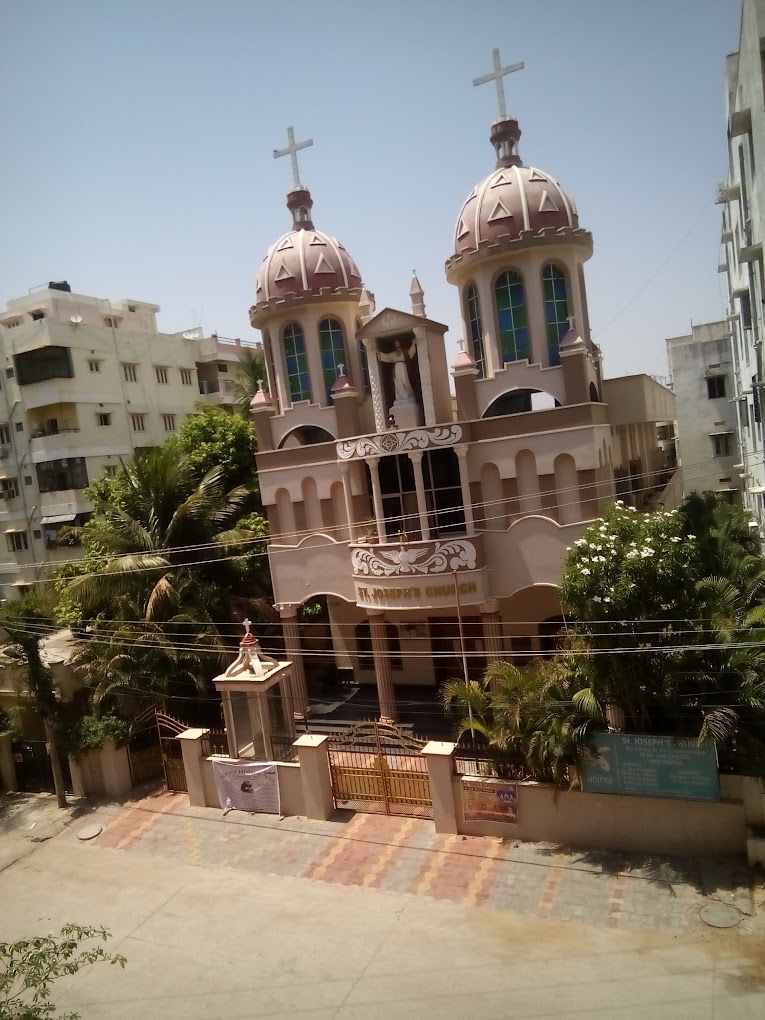
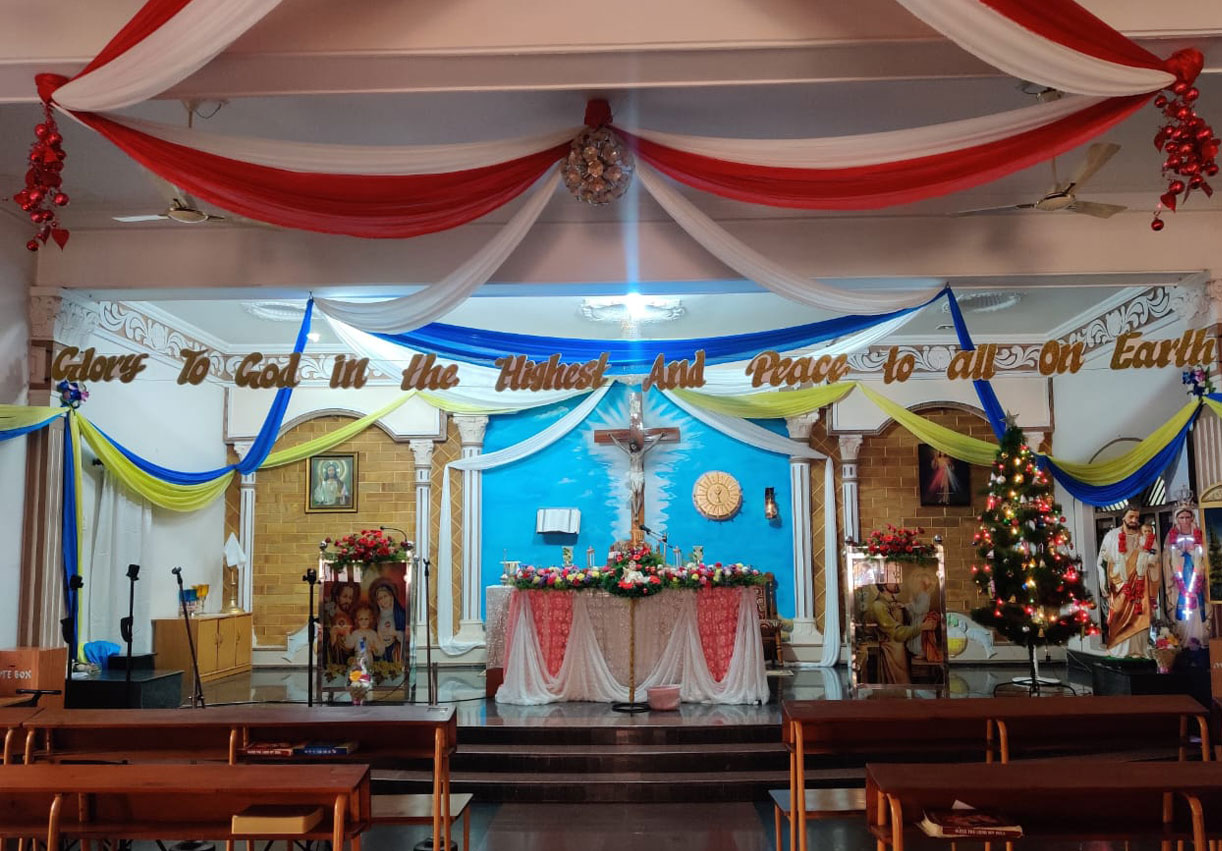
The beautiful and aesthetically elegant St. Joseph’s Church was designed by the Architect Gade Chinnappa Reddy. Located in the midst of a highly residential Colony, space was a constraint and so a double storied structure with the Church on the ground floor and the Parish Hall and Presbytery on the first floor was planned. The new Church was blessed and inaugurated on 23rd August, 2009 by Archbishop Marampudi Joji. On the same day it was also erected as a Parish and was rededicated to St. Joseph, the Worker as its principal Saint. Fr. Yeruva Balashowreddy was its first Parish Priest. Cherlapally Housing Project, which was initially promoted by certain individuals and was finally undertaken by the Hyderabad Archdiocesan Social Service Society (HASSS), was envisioned for providing low cost houses to poor Catholic families. The Capuchin Fathers were extending pastoral assistance to this Catholic Colony, namely St. Joseph’s Colony Cherlapally. Since 23rd August, 2009 with the erection of the new Parish, it was entrusted to the pastoral care of St. Joseph’s Church, Moula-Ali.
Soon there was change at the helm of affairs. In May 2010, Msgr. Thumma Solomon was appointed as the next Parish Priest of St. Joseph’s Church. Being well-experienced he ably led the community on the path to spiritual and communitarian growth. As any change is difficult, it took some time for people who were “used to” going to Arul Colony to turn their route to Moula- Ali. Slowly but steadily, people came. Once they came to “Moula-Ali Church” as it is now called, they never felt like going anywhere else, because of the warmth and homely feel the place and the Church exude. On 20th May, 2012 Fr. Selvakumar Aloysius was appointed the third Parish Priest of St Joseph’s Church. Fr. Kommareddy Mareddy is the present Parish Priest of St. Joseph’s Church.